Friday, October 14, 2011

Images

Cotton field on one of the roads leading to the monastery.

Welcome to Batesville, MS!

We have indeed arrived :)

Sign for Magnolia Village

This sign sits at the bottom of the dirt road that leads up to the monastery.  That's Thay's calligraphy!

Thay's calligraphy outside of the dining hall.  A gentle reminder to eat mindfully.

The Five Contemplations:

  1. This food is the gift of the whole universe: the earth, the sky, numerous living beings, and much hard, loving work.
  2. May we eat with mindfulness and gratitude so as to be worthy to receive it.
  3. May we recognize and transform our unwholesome mental formations, especially our greed, and learn to eat with moderation.
  4. May we keep our compassion alive by eating in such a way that we reduce the suffering of living beings, preserve our planet, and reverse the process of global warming.
  5. We accept this food so that we may nurture our sister- hood and brotherhood, strengthen our community, and nourish our ideal of serving all living beings.

The lotus pond and bridge.


Zen rocks outside of the nun's residence.

Home sweet home.

Our home for the week.


The "Look Deeply" family.  Our work and dharma family became very close in a short period of time.  They are all dear souls.

Thay makes his way to the morning Walking Meditation.

It was so peaceful to walk with him.

Getting ready to walk with Thay.

Thay and the children.

About 20 children walked in front of the line with Thay and never made a peep.  They seemed to pick up on his peaceful abiding.


Thay and one of the brothers walking mindfully to the morning dharma talk.

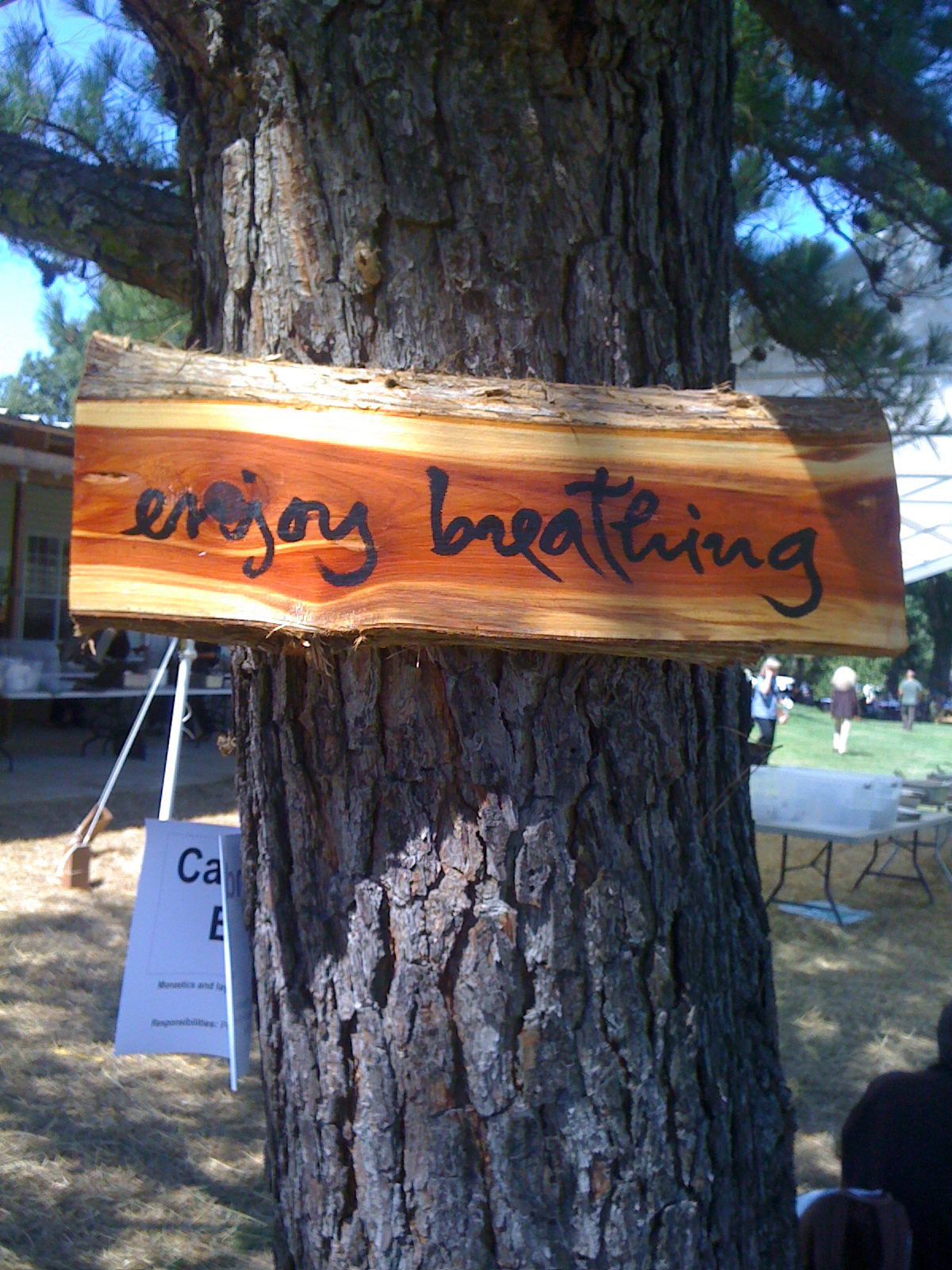
Reminders everywhere :)

Thay's notes.

The alter in the meditation tent.  Notice the lack of deities.

The alter says: "I have arrived.  I am home."

The mindfulness bell.

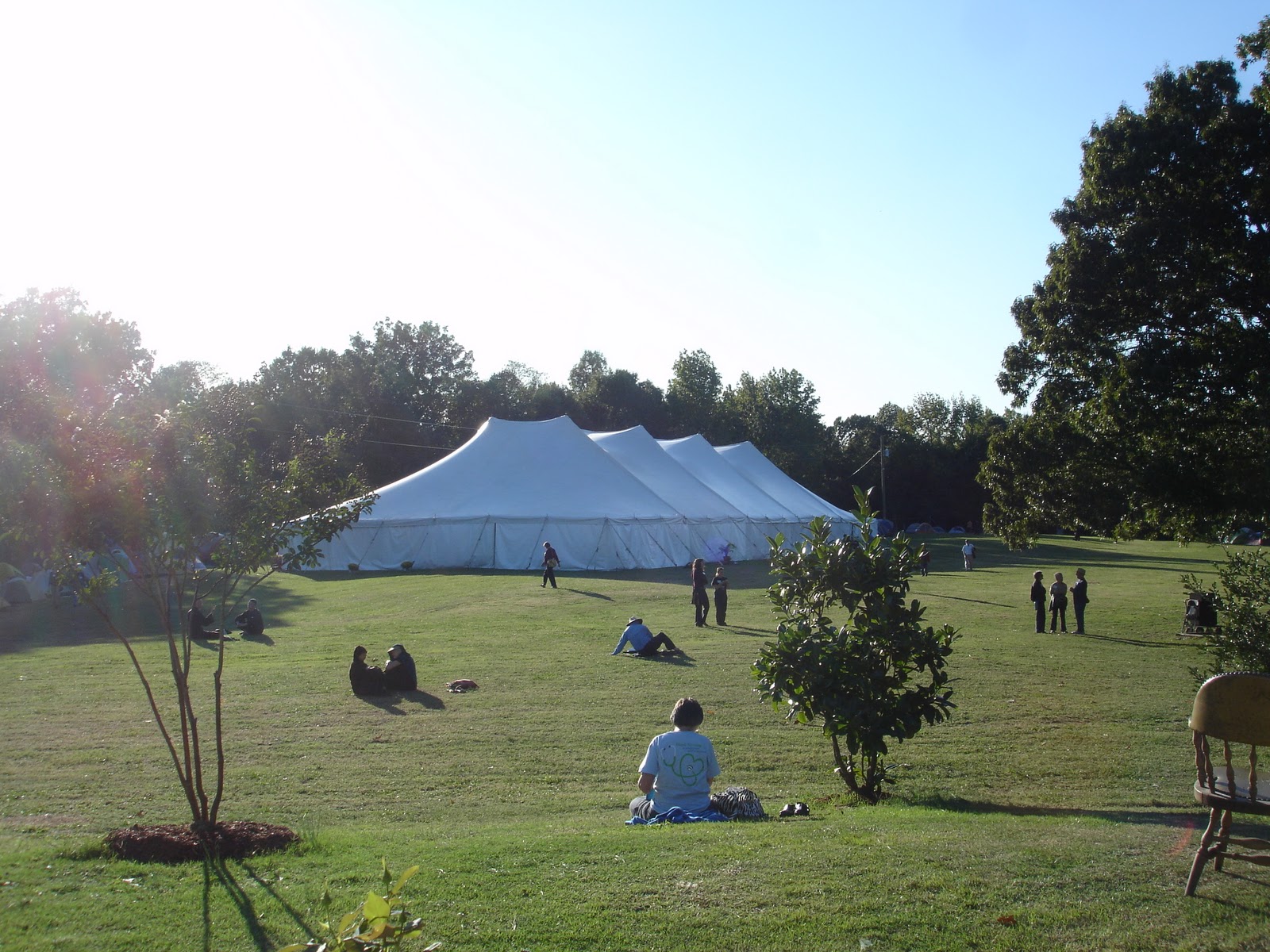
The meditation tent.

Thay jots down notes as he lectures.

View from our tent.  That's the nun's residence in the background.

Another view from our tent.

Our "home" started to get a little wonky by the end of the week :)

Late afternoon sun on the grape arbor.


Garden.


One of the out buildings...a storage shed, I think.

This is where the nuns live.  Their rooms are downstairs and they have a meditation space on the second floor.


Sun on the path outside the nun's residence.

Late afternoon sun.

Near the nun's residence, on the way to our tent.

Behind the dining hall. The tent to the right is where we washed our dishes.

The back of the dining hall (to the right) and the dish washing tent (to the left). 


One of the monastics.

Setting up the dish washing stations.

Sunny slope behind the dining hall.  A great place to get warm in the afternoon.

Behind the dining hall.  The meditation tent is to the left and the bathhouse straight ahead and to the right.

Meditation tent.

Men's camp ground.

Back of the Buddha Hall.

Side of the Buddha Hall.  This was where all of our announcements or messages were posted.  There were always many smiling monks or nuns peacefully gathered there.


The beautiful sister Chan Khong.


Sister Chan Khong signing her book.


No mud, no lotus.


One of the many lovely aspects of the retreat was, if you had a question about your practice, or had something weighing on you, one of Thay's monastics from Plum Village would happily set up a consultation with you and help you in any way they could.  The beautiful sister Huang Hau helped me in SO many ways.  


Walking with Thay.


Thay on a chilly morning, making his way to the meditation tent.


Watching Thay pass by.

Walking behind Thay.

Enjoying the present moment together.


Soaking up the exquisite sunshine on a cold morning.  Lyn, on the right was one of the first people we encountered at Magnolia.

Sitting in the sun with Thay.


One of the monks stopping to smell the flowers (and gather them too!).


Dear, sweet Thay.  This photo was taken by one of our work family members, John Cotterman. He has such a great eye.

Beloved teacher.

Releasing The Cows

“Each moment is a chance for us to make peace with the world, to make peace possible for the world, to make happiness possible for the world.”


Thoughts for Wednesday's blog and classes come from one of the dharma talks that Thay gave during our recent retreat with him.  It's a story that he often tells and in true Zen fashion, it is a simple reminder for us to come back to the happiness available in this moment.  It speaks to so many of us so I thought I'd share it:

Releasing The Cows
One day, after the Buddha and a group of monks finished eating lunch mindfully together in the woods, a farmer, very agitated, hurried by and asked, "Monks, have you seen my cows?!?  The Buddha asked him "What happened?" and the man said "Monks, this morning all 12 of my cows ran away.  And this year my whole crop of sesame seeds was eaten by insects! I don't think I can survive such misfortune!"  The Buddha said, dear sir, I'm so sorry, we have not seen your cows.  Perhaps they have gone in the other direction."  After the farmer went off in that direction, the Buddha turned to the monks and said, "Dear friends, do you know you are the happiest people on earth?  You have no cows or sesame plants to lose." 

We always try to accumulate more and more, and we think these "cows" are essential for our existence when in fact, they may be the obstacles that prevent us from being happy.  If you have too many cows to take care of, you will be very busy.  That is why, in order to be happy, you have to learn the art of cow releasing. 
Cow Releasing 101:
The purpose of our practice is to release our cows.  So, we release our cows one by one.  If we have too many "cows" inside or outside, we have to let them go them in order to create space. Without space we can't be happy.  Without space we become preoccupied with lots of things, we worry about lots things, we pack our days full of too many plans, and we think all of them are necessary to our happiness, but it's not true. As we release more cows, we will be happier, lighter and have more freedom.
We can do everything – walk, drink tea, talk – in a way that improves our freedom.
There is no need to do things in a stressful way. We can start by limiting ourselves to few projects and commit to do them with mindfulness, joy and clarity. We can refuse to be drawn in by the number of cows we have. We sacrifice them because our freedom and wellbeing are important.
We have to learn to live in happiness in this moment, to touch in peace and happiness what is available now.
If someone asks us: "Have you experienced the happiest moment in your life?", we may say, "It will happen soon." But, if we continue to live in such a busy way, it may never appear. 
We must make this moment into the most wonderful moment and we can do it if we stop running toward the future, stop worrying about the past, and stop accumulating so many cows.
You are free human beings; you are alive. Open your eyes and enjoy the splendor of the sun, the blue sky and the wonderful children around you.
Breathing with awareness inside and out assists you to be in your best – relaxed, fresh, stable, serene, free and able to enjoy this moment as the most wonderful moment of your life. 
So, we have to ask ourselves; what is really essential to our happiness?  Will we be happy only when we get that new expensive purse?  Will our happiness begin when we can sell our house and move to sunny California?  Will we finally be content when we acquire that promotion or title?  

We all have cows or conditions that seemingly prevent us from being happy. That's why releasing the cows around us and letting go of the preoccupations inside of us is an essential condition for happiness. This is the space we are talking about when we practice. I am space; within and out. I feel free. Freedom is the real foundation of happiness.
When we start to unbury ourselves from our internal and external stuff, we will find more access to our experience, and more space to breathe, move, love, and have compassion.  In addition to feeling lighter with less to carry, we will have more time to spend with others, and more energy to contribute to the world as well.

What are some of your cows?  What are some of the conditions that are keeping you imprisoned in fear, busyness, worry?  Release the cows and find that happiness resides in freedom and spaciousness.

Until next time... let the cows roam free! :)

Exactly.

I read this recently and it says it all.  Just thought I'd share :)


By ELISHA GOLDSTEIN, PH.D.


mindfulnessWe spend a lot of our attention day in and day out, knowingly and unknowingly trying to be somewhere else than where we are. You may have had this thought before, but still the same process continues. It’s as if our mind is in the business of constantly trying to evade life as it is.
On the subtle end it’s when we’re in the shower and planning what needs to get done at work, on the more blatant end it’s when we have a fear of heights and we stay away from getting on anything that’s taller than us. What would life be like in the days, weeks and months ahead if you truly believed the following thought?
No matter where I am, especially if I am facing a fear or pain, I am exactly where I need to be.
The truth is we cannot gain freedom in this life or even in this moment if we cannot learn the skills of being with life as it is.
The moment we recognize that we can “be with” what’s here and the moment we especially realize that with fear is the beginning of a fundamental awakening. It’s when we see that we have much more freedom in this world than we ever knew.
It’s also the moment when we start being on the lookout for fear, but in an entirely different way. We’re not anxiously afraid of fear where we walk around like a blanket of gasoline ready to erupt with any spark. We’re actually looking for the fear so we can continue to show ourselves that everything is going to be okay.
What would the days, weeks and months be like in your life if you had a credible voice inside that was saying “everything is going to be okay?”
That is the voice we begin to cultivate as we practice mindfulness of fear in our lives.
It doesn’t happen overnight for most of us, it isn’t an enlightenment that changes the face of our lives forever as has seemed to happen to very few people. It is a gradual shifting that continues to be practiced, nourished and grown over time.
The truth is you are exactly where you need to be, even in the face of fear and pain. Be gentle with yourself and what it’s like to hold this with a heart of compassion. You can say to yourself, “Breathing in I recognize this fear or pain, breathing out, holding it with a heart of compassion.” At the same time, know your limits. It be a source of wisdom to turn away from pain at times in the face of deep trauma and it can be skillful to get the support of a professional.
Take this with you today.

Thursday, October 13, 2011

Touching The Earth (Monastery Visit Part Four)

Earth brings us to life and nourishes us.  
Earth takes us back again.
We are born and we die with every breath.
-Thich Nhat Hanh
(photo of the monastery grounds just outside the nuns residence)


It's hard to believe that over a week ago, John and I and 898 other souls were spending the last of our five days at Magnolia Grove Monastery with dear Thay. 

I am amazed at how much transformation can occur in the space of just five days.  A lot of it had to do with how stripped down life is at the monastery. Life is deliciously basic and uncluttered. A lot of it has to do with Thay's teaching which is also deliciously basic and uncluttered - truly Zen.

As I mentioned in an earlier post, John and I camped in a tent during our visit to Magnolia Grove.  We had originally planned to commute (to stay in a hotel and drive back and forth to the monastery), but after re-examing the logistics as well as our finances, we decided that camping might be the way to go.  I am SO glad we did.  Staying in a hotel and leaving the monastery grounds each day would have detracted from the total immersion in mindfulness and simple living. 

For the record, I've only been tent camping once.  I was a footloose and fancy free woman of 21 (over 20 years ago, y'all!).  I remember not sleeping a wink as cold rain dripped ceaselessly through the old, canvas tent we were using, and almost getting crushed by an early morning stampede of moose in the mountains of New Hampshire.  Good times.  John has only been tent camping once or twice as well. His family used to take trips with a pop-up camper, but that hardly qualifies as "roughing it".

So, it was through the lovingkindness and generosity of friends that we were able to have the amazing experience of tent camping during our week at Magnolia Grove.  With kind donations of a HUGE tent, two cots (with mattresses!), folding canvas chairs, and lanterns, we sallied forth into the unchartered territory of living life in the great outdoors. 

Living in the open, so close to the earth and the natural cycles of nature really puts things in perspective.  You are brought back to living with the very basic necessities: food, shelter, warmth, light.

One of the greatest pleasures during our stay at Magnolia, was the feeling of the sunlight on our face as the sun came up on a cold morning. We would all be silently sitting at picnic tables or on benches with our steaming bowls of oatmeal and cups of hot tea, feeling warm inside but chilled outside. After washing the dishes behind the dining hall, we would slowly make our way back to our tents to prepare for the morning activities. Usually by then the sun would have climbed up high enough to peek over the trees and shine strongly on the open fields and spaces around the monastery buildings.  The most delicious part of the day was taking a few moments to pause and feel the exquisite warmth of the sun after a long, cold night.  To see fifty or so faces turned to the sun with their eyes closed with a look of pure joy was uplifting.

Getting close to the earth, touching the Earth, helps us to recognize that we're not alone but connected to the whole stream of people who came before us, our spiritual and blood ancestors.  Thay says: "We touch the Earth to let go of the idea that we are separate and to remind us that we are the earth and part of life...when we touch the earth we become small, with the humility and simplicity of a child.  When we touch the earth we become great like an ancient tree sending her roots deep into the earth, drinking from the source of all waters.  When we touch the earth, we breathe in all the strength and stability of the earth, and breathe out our suffering - our feelings of anger, hatred, fear, inadequacy and grief."

At the studio on Sunday, we used grounding postures and deep breathing to come back to our roots.  We used a variation of Thay's "Touching The Earth" meditation to deeply touch the elements within us that are connected to not only a long, unbroken lineage of ancestors but also to the land.  It's a wonderful way to remind ourselves that we are a part of everything and everything is a part of us.  It's a wonderful way to practice perspective.

Until next time...
The Five Earth-Touchings

Taking a moment to think of, with gratitude, all generations of ancestors in your blood family.
See your mother and father, whose blood, flesh, and vitality are circulating in your own veins and nourishing every cell in you. Through them,  see your four grandparents.  see your roots in your father, mother, grandfathers, grandmothers, and all your ancestors.  Know you are only the continuation of this ancestral lineage. Their expectations, experiences, and wisdom have been passed down from so many generations of ancestors.

You carry in you the life, blood, experience, wisdom, happiness, and sorrow of all generations. Open your heart, flesh, and bones to receive the energy of insight, love, and experience passed down to you by your ancestors. 

See your parents when they were children, young and innocent, fresh to this world and free from hurt. See their innocence and feel love, compassion and sorrow for their hurts.

Know that parents always love and support their children and grandchildren, although they are not always able to express it skillfully because of difficulties they themselves encountered. 

See that your ancestors tried to build a way of life based on gratitude, joy, confidence, respect, and loving-kindness. As a continuation of your ancestors, feel a sense of gratitude and allow their energy to flow through you.  Feel their support, protection, and strength.
Taking a moment to think of, with gratitude, all generations of ancestors in your spiritual family.
See in yourself all of your teachers, the ones who show you the way of love and understanding, the way to breathe, smile, forgive, and live deeply in the present moment. 

See the many wise and courageous women and men (known and unknown to us) who have shown us the way.  Know that their energy has deeply transformed the world. Their energy has entered you and is creating peace, joy, understanding, and loving-kindness.
Open your heart and your body to receive the energy of understanding, loving-kindness, and protection from all who have shared wisdom with you.  Know that you are the continuation of their teachings.  Ask these spiritual ancestors to pass on their infinite source of energy, peace, stability, understanding, and love and vow to use this energy to practice so that I can transform suffering in myself and in the world, and to pass on their energy to future generations of practitioners.
Taking a moment to think of, with gratitude,  this land and all of the ancestors who made it available.
Feel how you are whole, protected, and nourished by this land and by the living beings who have made life easy and possible for me through all their efforts. See all those who have worked hard to build schools, hospitals, bridges, and roads, to protect human rights, to develop science and technology, and to fight for freedom and social justice.

Feel the energy of this land penetrating your body and soul, supporting and accepting you.

Taking a moment to pass on, with gratitude and compassion, your energy to those you love.
All the energy you have received, pass it back on to your father, your mother, everyone you love, and all who have suffered and worried because of you, and for you.

Know you have not been mindful enough in your daily life.  Also know that those who love you have had their own difficulties.  See that they have suffered because they may not have been lucky enough to have an environment that encouraged their full development, and feel compassion for their suffering. 

Pass your energy on to your beloved ones: mother, father, brothers,  sisters,  husband,  partner,  wife,  daughter,  son; to the family of friends you have created around you; and to the husband, wife, partner, and children you may have in the future.

Pass on your energy so that their pain will be relieved, so they can smile and feel the joy of being alive.  Send a wish for all of them to be healthy and joyful. Know that when they are happy, you will also be happy.  No longer feel resentment towards any of them. Know that you are not separate from them but rather one with those you love.
In understanding and compassion,  reconcile yourself with all those who have made you suffer and open your heart, sending your energy of love and understanding to them.
Know  that these people have themselves undergone a lot of suffering and that their hearts are tight with pain, anger, and hatred.  Touch that pain and feel its sorrow and see that anyone who suffers that much will make those around him or her suffer.  Know they may have been unlucky, never having the chance to be cared for and loved. Life and society have dealt them so many hardships. They have been wronged and abused. They have not been guided in the path of mindful living. They have been stripped of the innocence and joy of life. They have accumulated wrong perceptions about life, about me, and about us. They have wronged us and the people we love.

See their suffering and do not  hold any feelings of hatred or anger in yourself toward them. Channel your energy of love and understanding to them. 


Wednesday, October 12, 2011

No Longer In A Hurry (Monastery Visit-Part Three)

Happiness is here and now
I have dropped my worries
Nowhere to go, nothing to do
No longer in a hurry
Happiness is here and now
I have dropped my worries
Somewhere to go, something to do
But I don't need to hurry
(Plum Village song)
(The mindfulness bell at Magnolia Grove Meditation Center)

After arriving at Magnolia Grove Monastery last week, we were greeted by the many smiling, peaceful faces of the monastics who live, work and were visiting there.  We were a few hours early and were invited to set up our campsite and settle in.  Being early we were surprised to note that at no time could one discern that 900 people were about to descend.  There was an air of mindful work and peace surrounding the monks and nuns.  No scrambling, no shouting, no panicked last minute preparations, just calm abiding.

Once we registered, went through orientation and prepared for our first meal, we heard the peal of a warm-toned bell.  As the bell rang, we noticed that everyone mindfully stopped what they were doing and enjoyed three deep breaths in and out together before returning to their tasks.  It wasn't long before we realized that this bell rang periodically (about every 15 minutes or so).

As I looked around the first several times the bell rang and I stopped to breathe, I was profoundly moved by the vision of so many people moving in different directions, doing different tasks, stopping and mindfully existing in the present moment.  It was powerful.

I don't consider myself someone who zips around or is bursting with hyper energy, but after a day at the monastery, surrounded by the energy of mindful activity, I could distinctly feel the deeply rooted presence of rushing in me.  The realization that, in the course of our daily lives we become numb to the momentum and pace of the world around us, hit me like a ton of bricks.  Without being aware that it's happening, we start to vibrate with the forward surging energy that surrounds us.   To have had the opportunity to step away from that energy and observe the tendency to hurry and rush was indeed a gift with profound benefits.

Thay says: "We often become so busy that we forget what we are doing or even who we are.  I know people who say they even forget to breathe!  We forget to look at the people we love and to appreciate them until it is too late.  Even when we have some leisure time, we don't know how to get in touch with what is going on inside of ourselves.  So we turn on the television or pick up the telephone as if we might be able to escape from ourselves.

To meditate is to be aware of what is going on - in our bodies, our feelings, our mind, and in the world.  When we settle into the present moment, we can see beauties and wonders right before our eyes - a new born baby, the sun rising in the sky.  We can be very happy just by being aware of what is in front of us."

By repeatedly returning back to the present moment and slowing down, you continuously come back to the wonders of life that are only available in the here and now, and your relationship with life takes on a whole new, deeper meaning.  You soon discover that eternity is available in the present moment. 

Spending a week vibrating at this slower, more mindful energy was truly a gift that planted deep-seated seeds.  What I realize now is that we don't need to go off to spend time at a zen monastery, go away on vacation, or close ourselves off from the world to experience this stillness of being.  It's available right here.  Right now.  So simple.  All it takes is for us to be willing to see that we're the ones creating the hustle and bustle, often in an attempt to outrun ourselves.  If we wish to slow down, we can indeed... slow down.  

Next time you're in a hurry, take a moment to close your eyes and take three full, long, slow breaths in and out.  Slowly open your eyes and feel the difference those three breaths made.

Until next time...

"Driving the Car Meditation"
(From: Present Moment, Wonderful Moment)
Before starting the car,
I know where I am going.
The car and I are one.
If the car goes fast, I go fast.

If we are mindful when we start our car, we will know how to use it properly.  When we are driving we tend to think of arriving, and we sacrifice the journey for the sake of the arrival.  But life is to be found in the present moment, not in the future.  In fact, we may suffer more after we arrive at our destination.  If we have to talk of a destination, what about our final destination, the graveyard?  We do not want to go in the direction of death;  we want to go in the direction of life.  Life can be found only in the present moment.  Therefore, each mile we drive, each step we take, has to bring us into the present moment.

When we see a red light or a stop sign, we can smile at it and thank it, because it is a bodhisattva (teacher) helping us return to the present moment.  The red light is a bell of mindfulness.  We may have thought if it as an enemy, preventing us from achieving our goal.  But now we know the red light is our friend, helping us resist rushing and calling us to return to the present moment where we can meet with life, joy and peace.

Saturday, October 8, 2011

No Distinctions (Monastery Visit-Part Two)

“The Sangha is invited to come back to their breathing. Let the whole Sangha breathe as one body, chant as one body, listen as one body and transcend the boundaries of the delusive self, liberating from the superiority complex, the inferiority complex, and the equality complex.”
(Thich Nhat Hanh)


One of the most profound moments of realization from our recent trip to Magnolia Grove Monastery came when, during a question and answer session, a young girl named Quin asked Thay:  "I wanted to ask how I can relate to another person and love the person with my whole heart and not feel superior, or inferior or equal to the person.  It's a very hard concept for me to grasp because sometimes I feel jealous or inferior than another person and it makes me suffer a lot."  Thay answered gently: "When we see the other person, we should recognize that in him or her there is suffering also.  There is suffering in us for sure, but there is suffering in him and in her too, so you have something in common - both of you suffer. Based upon that it is possible to help each other to suffer less. And you forget about that you are equal to him or better than him or are worth less than him.  To suffer is not a bad thing.  Suffering is an ingredient with which we can make happiness  The practice consists of learning how to make good use of the suffering in order to create happiness.  We know that comparing and these other complexes create suffering, so we give priority to the practice of recognizing the suffering in us and in the other person.  The first thing we do is to help them to suffer less, because that person may look like she does not suffer, but that's not true... that is not true.  That person may look very fancy, but there is one thing that is certain; there is suffering in him or in her, and if you can touch that compassion in you it will arise and it will protect you from afflictions such as jealously, superiority, and inferiority."

When we meet or see others, there is often a tendency to compare.  There always seems to be a part of us that is summing up whether we are superior, inferior or equal to the person we see or meet.  Our practice helps us to free ourselves from all distinctions, to understand that I am in you and you are in me.  No distinctions.  No separation.  Just inter-being as Thay calls it.  This has helped me immensely in the few days it's been since Thay talked about it.  When a situation arises that causes either of these complexes to surface, I come back to my breath and remind myself that there are no distinctions between myself and the person in front of me.  

When we look deeply and touch the heart of our suffering, we recognize and connect with each person we come into contact with on a profound level.  This is how we open the door to our heart.

Next time you find yourself confronted with feelings of superiority, inferiority or even equality, look deeply at the person in front of you and with your whole heart, recognize their suffering, remember you suffer too and know that you both share the capacity to create happiness out of this shared suffering.

Until next time...
 
(photo by John Cotterman, one of our work family members on the retreat)

Please Call Me By My True Names
Portion of a poem by Thich Nhat Hanh

My joy is like a spring, so warm
it makes flowers bloom all over the Earth.
My pain is like a river of tears,
so vast it fills the four oceans.

Please call me by my true names,
so I can hear all my cries and laughter at once,
so I can see that my joy and pain are one.

Please call me by my true names,
so I can wake up
and the door of my heart
could be left open,
the door of compassion.


Friday, October 7, 2011

Home (Monastery Visit, Part One)

"May we awaken from forgetfulness and realize our true home..."


One of the first things we encountered as we turned up the road towards Magnolia Grove Monastery was a small, white sign with the words: "I have arrived, I am home" hand painted in grass green paint.  I smiled.  This is one of Thay's favorite sayings and it is the root of his practice and his teaching.  The fact that it was the first thing we saw of our destination after a long journey was sweet.  We had indeed arrived.

The monastery sits on about 120 acres of rolling farmland in rural Batesville, Mississippi, about 10 hours due west of Columbia.  As we drove up the dirt road that leads to Magnolia Grove, we were full of excitement and wonder.  We had no expectations, just a sense of being open to taking in all that the week had to offer.

After setting up our tent and settling in, we began to explore the grounds.  The monastery was surprisingly calm and still in light of the fact that nearly 900 people would be arriving within hours.  We begin to see monastics dressed in traditional brown robes, with shaved heads, and non las (pointy bamboo or leaf hats), setting about their assigned tasks very slowly and mindfully.  Everyone was smiling and working steadily.  Their sense of calm and ease was contagious.  We immediately felt at home.
We spent the entire week outside with the exception of the bath house which was the only enclosed, heated dwelling that we used.  We were essentially "homeless" for the week; living in a tent, eating every meal outside, using the meditation hall tent, and gathering with Thay each morning for walking meditations through the forests and fields of the monastery grounds.  Being stripped of our "things" (our house, our comfy bed, our closets full of clothing, our televisions and computers) heightened the realization that home is not in "things", it is in us.  It's wherever we happen to find ourselves, in any given moment.  

Thay was born in Vietnam in 1926.  When the Vietnam War broke out in the 60's (the Vietnamese call it "The American War") and after witnessing unspeakable violence and the suffering of so many people, Thay spoke out against the war and was exiled by the Vietnamese government from his country.  He ended up seeking political asylum in France where he has lived ever since.  Thay talks about being stripped of his nationality and about how though he was taken in by the French, that France wasn't his true home either.  He speaks about how in those early years of exile, he suffered homesickness and sadness until he realized that "home" is not where we live or where we were born.  Home is in us.

Our true home is not limited to a place or a time. Our true home cannot be described by geographical location or in terms of culture.  Life is our true home.  The expression “I have arrived, I am home" is the embodiment of our practice.  It expresses our understanding that the past is no longer a prison for us, that the future is no longer a prison for us.  We are able to live in the here and the now.

Thay says, "Our true home is in the present moment, whatever is happening right here and right now. Our true home is the place where we no longer seek, no longer wish, no longer regret.  We begin to see that the future is available in the present, and when we touch the present moment deeply, we touch the past; and if we know how to handle the present moment properly, we heal the past.

Our true home is not the past; it's not the object of our regrets, our yearning, our longing, or remorse.

Our true home is not the future; it's not the object of our worries, hopes or fears.  Our true home lies right in the present moment.  If we can practice returning right here and right now, then the energy of mindfulness will help us establish our true home in the present moment."

So whether we are hundreds of miles from our brick and mortar home, or camping outside in a tent, or walking through the aisles of the grocery store, we can remind ourselves to arrive and to be "home" in these very moments by connecting with our breath.

To arrive, simply inhale and silently say: "I have arrived", and exhale repeat: "I am home".  Do this as many times as it takes to drop your grasp on the past and worry about the future.  Arrive in the here and the now and find peace.

Until next time, please enjoy Sister Chan Khong, one of the nuns we met this week, sharing her happiness :)  Enjoy!