Showing posts with label Kimberley Puryear. Show all posts

Tuesday, January 3, 2012

The Garden of The New Year


I spent the last hour of 2010 in silent meditation. The year had been a tough one. John and I had each suffered from serious illnesses that took time and patience to recover from. It had also been a very emotional year for me - a time of looking deeply inward to investigate and come face-to-face with some things that needed to shift and change. So, it was fitting for me last New Year's Eve to end the year in the sweetness of solitude and introspection. In the quiet, waning hours of 2010, I sat in silent meditation and found clarity. In the stillness, I set my intention(s) for 2011. They were simply to love more and to let go.

It's funny, looking back through the days and months of 2011 to see how, as a result of setting these intentions, the universe provided everything I needed and more to manifest them. This doesn't mean that the going was easy. There were times that were downright painful, but each experience brought me a little closer to realizing my vision for the new year.

The "loving more" part of my intention was nurtured easily through connecting more with others, cultivating community, and finding clarity in my practice through time spent with an amazing teacher.  Loving more also had its painful moments when presented with challenging situations that called for cultivating a great deal of compassion - both for myself and for others.

The "letting go" part of my intention arrived slowly, with a lot of introspection, and not at all as I had envisioned, but somehow more beautifully than I could have imagined.  Funny how that happens, isn't it?

The new year is a natural time to think of starting fresh.  I like to think of it as if we've been given a fertile patch of freshly sown earth that's free of weeds, stones, and all the blockages that keep us from living our deepest purpose.  It's there just waiting to provide us with abundance and fullness.  As we unfold into the new year, we cultivate that patch of earth by planting and watering the seeds of our intentions with our awareness, our actions, compassion and mindfulness.  The more we water and nurture our garden, the more we can reap the rewards of its bounty.

Wishing you a fertile and bountiful new year.  

Until next time...


To Students and Friends

Paramhansa Yogananda, Inner Culture, January 1937

The New Year has come to greet you with new hopes, new determination, new will-to-achieve, new activities. In the Temple of the New Year renew your reverence for the unlimited hidden power of God within you. The trails of trials and the yawning chasms of woe have been left behind in the dark night of the past–now you are entering the daylight of a new-born hope of the New Year. Cast off the coil of the decayed thoughts of the past years; be reincarnated into vital living of the New Year.
Every regret for shattered hopes of success must be transformed into the joy of new achievements during the New Year. Old sorrows and disappointments must be buried beneath the sepulcher of the past year. Those dark bandits of discouragement must not remain any longer to steal the wealth of your desire to succeed.
Every day in the New Year must become an altar for the God of new living, new achievements in wisdom, and new joy. Every day in the New Year must bring hope and cheer to yourself and all humanity.
Take all the salvaged treasures of good experiences from the sea of past experience and use them to buy new accomplishments in the New Year. In the garden of the New Year culture the seeds of well-planned new activities until they grow into fragrant flowering plants of diverse successes. Let every day in the New Year become a step upward on the ladder of your Self-Realization. Make every day of the New Year a better day than the previous one for greater effort to succeed in business, family happiness, and increasing the ever-new joy-contact of God in meditation. The old year has gone, but the New Year is full of treasures for you to use.
Bury the bad habit of failure in the tomb of the old year and reincarnate your life energy in the vitality of the New Year. May the New Year spread the example and message of your renewed life and renewed power unto all Creation.

Friday, November 18, 2011

Mother Mindfulness


“The child is in me still and sometimes not so still.”  
-Fred Rogers

I recently spent some time with one of my oldest and dearest friends, Claire and her gorgeous baby daughter, Vivienne.  One thing that strikes me as utterly beautiful and amazing is how loving and patient Claire is with her children. I've known her for a long time and it warms my heart to see her blossoming into such an extraordinary mother.

Having grown up with loving yet somewhat impatient parents, I am inspired by Claire's ability to deliver comfort with patience and ease.  Her love and nurturing is beautiful to witness. Though I'm sure at times Claire is not feeling so patient, she rarely lets it show and instead simply allows Vivienne to have her tantrum by holding her calmly, soothingly, and not putting her down until the strong emotion or sensation has dissolved.

Regardless of how much love we received or did not receive as children, regardless of how much older, wiser or more mature we've become, we all have an "inner child" existing somewhere beneath the surface.  Most of the time when a strong emotion passes over us as adults, its roots reach far back to an experience or experiences that we had as children. These seeds that were planted long ago can affect the feeling of not belonging, of not being listened to or heard, a feeling of being afraid, inferior, angry, vulnerable or alone.  These seeds grow into big emotions when, as adults, we are faced with the very same experiences that planted those seeds in the first place (a spouse who isn't hearing your needs, an impatient co-worker who says something to make you feel inferior, etc).  Sensing this, our inner child starts to have a tantrum and often times there is no one there to soothe those strong feelings.

Enter the practice of mindfulness.  Thich Nhat Hanh says that mindfulness can act as a nurturing mother in times of powerful feelings.  He says that we can soothe the strong emotions we encounter by cradling them with mindfulness.  We can go home to ourselves and comfort the little child inside, listen to our child, and respond directly to him/her.

As a part of my practice, whenever I feel a strong reaction to something, I immediately bring my attention to it (instead of pushing it away or suppressing it) and I allow my attention to hold it, like Claire holds a fussy Vivienne.  I acknowledge the presence of anger, sadness, anxiety, remorse, judgement, etc. and let it know that I am there for it, holding it and not abandoning it until it feels soothed and attended to.  Once I do this, the intensity of the emotion begins to subside and I can act from a place of compassion and clarity instead of anger or defensiveness.  It's a very simple but powerful practice!

Practice this today and every day and watch your reactions, your suffering and your misperceptions be transformed.  Do this for yourself, your loved ones and the world.

Until next time...

“The most sophisticated people I know - inside they are all children. ” 

Taking Care of Anger
(from the Plum Village website: www.plumvillage.org)

"Thay often compares our anger to a small child, crying out to his mother. When the child cries the mother takes him gently in her arms and listens and observes carefully to find out what is wrong. The loving action of holding her child with her tenderness, already soothes the baby’s suffering. Likewise, we can take our anger in our loving arms and right away we will feel a relief. We don’t need to reject our anger. It is a part of us that needs our love and deep listening just as a baby does.

After the baby has calmed down, the mother can feel if the baby has a fever or needs a change of diaper. When we feel calm and cool, we too can look deeply at our anger and see clearly the conditions allowing our anger to rise.

When we feel angry it is best to refrain from saying or doing anything. We may like to withdraw our attention from the person or situation, which is watering the seed of anger in us. We should take this time to come back to ourselves. We can practice conscious breathing and outdoor walking meditation to calm and refresh our mind and body. After we feel calmer and more relaxed we can begin to look deeply at ourselves and at the person and situation causing anger to arise in us. Often, when we have a difficulty with a particular person, he or she may have a characteristic that reflects a weakness of our own which is difficult to accept. As we grow to love and accept ourselves this will naturally spread to those around us."


Thursday, November 17, 2011

Walking

Wanderer, your footsteps are
the road, and nothing more;
wanderer, there is no road,
the road is made by walking.
By walking one makes the road,
and upon glancing behind
one sees the path
that never will be trod again.
Wanderer, there is no road--
Only wakes upon the sea.

-Antonio Machado

I love to take walks.  I suppose it's because, like yoga, walking can be a moving meditation, a way to see where we are resisting life, and a tool to help us to let go of the resisting. As I walked yesterday morning, I was reminded of the beauty of just being: warm sunlight, cool air, the scent of drying leaves, freshly cut grass, the sound of leaf blowers in the distance, hawks calling out high overhead, the scratching sound of squirrels chasing each other around trunks of trees, the soothing sound of gentle breezes moving the tops of trees sending colorful leaves gracefully tumbling to the ground, the way my feet connected with the earth without me having to think about it. Such miracles! We practice walking so that each step quietly unfolds in front of us and so that we can be there to witness that unfolding.  We walk simply to walk and enjoy the miracle of being alive.  We walk to awaken to the conditions of happiness and contentment that exist around us and in us.

Our practice - whether it is walking, breathing, asana, meditation - is a good remedy for our wayward minds and forgetful hearts.  It reminds us to live our lives with our eyes, hearts, and minds open.  It reminds us to really see, experience, and feel without regret or remorse.  Our practice points us towards kindness and love and we endeavor to allow ourselves to unfold into each moment as it arrives. 

I suppose the trick is to trust that the path will unfold with each step taken, not getting stuck where we've been or caught up with where we're headed, just awakening to what is in us and around us NOW.  Practice is creating the art of living beautifully, honestly and with strength and dignity.  If we want to live in peace with ourselves, each other and the earth, we practice dedicating ourselves to walking mindfully through the world.  We can understand this intellectually, we can read about it, hear dharma talks about it, but until we actually practice experiencing it, we cannot know its true meaning. Our life is the practice.

Try it today.  As you walk through your day, be aware of how you're moving, breathing, thinking.  Take the time to pay attention and to become more mindful of the energy you bring to your life and the world.

Until next time...

“People usually consider walking on water or in thin air a miracle. But I think the real miracle is not to walk either on water or in thin air, but to walk on earth. Every day we are engaged in a miracle which we don't even recognize: a blue sky, white clouds, green leaves, the curious eyes of a child -- our own two eyes. All is a miracle.”
― Thich Nhat Hanh


Walking Meditation 
(in the tradition of Thich Nhat Hanh)

Wherever we walk, we can practice meditation. This means that we know that we are walking. We walk just for walking. We walk with freedom and solidity, no longer in a hurry. We are present with each step. And when we wish to talk we stop our movement and give our full attention to the other person, to our words and to listening.

Walking in this way should not be a privilege. We should be able to do it in every moment. Look around and see how vast life is, the trees, the white clouds, the limitless sky. Listen to the birds. Feel the fresh breeze. Life is all around and we are alive and healthy and capable of walking in peace. Let us walk as a free person and feel our steps get lighter. Let us enjoy every step we make. Each step is nourishing and healing. As we walk, imprint our gratitude and our love on the earth. We may like to use a mantra as we walk. Taking two or three steps for each in-breath and each out-breath:
Breathing in "I have arrived"; Breathing out "I am home"
Breathing in "In the here"; Breathing out "In the now"Breathing in "I am solid"; Breathing out "I am free"Breathing in "In the ultimate"; Breathing out "I dwell"

Tuesday, October 18, 2011

Lessons From A Kiwi

“When we are mindful, deeply in touch with the present moment, our understanding of what is going on deepens, and we begin to be filled with acceptance, joy, peace and love.” -Thich Nhat Hanh 

Look at this beautiful kiwi fruit.  Suppose you've never eaten a kiwi and you asked me to describe it to you. I could explain how it's small, oval shaped, and fits in the palm of my hand, or how its skin is slightly fuzzy, yet slightly rough.  I could describe the bright green flesh that is speckled with tiny black seeds and how it has an almost creamy texture.  Or how it tastes slightly like strawberries, banana and melons combined.  I could slice one open and show you its beautiful green starburst insides, but until you actually hold one in your hand, or taste its juicy sweetness, or see its vivid color, you can never truly know what it's like to experience a kiwi.  You can never really know the truth of eating a kiwi, right?


In order to understand the ultimate truth of any situation, you have to stop being an observer and become a participant.  In order for true understanding to be possible, you have to remove the barrier between observer and the object being observed.  You can read about, or listen to or watch something be explained, but in order to fully understand the truth about the object of your attention, you must experience it.  Explanations are just notions and concepts, and notions and concepts can never be the reality. Experience is how we cultivate insight - deep intuitive understanding.

Until I had experienced true mindfulness at Thay's retreat, I only had notions and concepts about it.  I studied a lot about it, I understood it on an intellectual level, but it wasn't until I experienced it first hand for an extended period of time that the truth of it awakened in me.

Our teachers (yoga and meditation, or otherwise) can describe for us the experience of a posture, breathing techniques, or what meditation is or is not, but ultimately it is up to each practitioner to take the notions and concepts that they are provided with and find their own experience and insight. 

When we begin class with the bell of mindfulness, it's an invitation for us to turn our full attention to the practice of finding the truth of each moment.  The bell is a powerful reminder to let go of notions and concepts and absorb the experience of the truth of being, without adding anything extra.  We practice "tasting" each posture and noticing the texture of our thoughts, the richness of our breath and the weight of our awareness.

Until next time…


The Light of Understanding

"Understanding means throwing away your knowledge.” Experience is your best teacher.
-Thich Nhat Hanh


Life since the retreat has been really interesting.  In many ways I feel as if I've been re-born, if that makes sense. I've been re-learning how to walk, speak, eat, and move through the world in this new, mindful way.  In an email to my dharma teacher last week, I said that I feel as if a huge light switch has been turned on in me and I really don't want the lights to go out again. Practice, practice, practice.

Over the past week or so, when things have gotten busy, I've found myself sort of wishing that living in the world wasn't as challenging as it often seems to be.  But then I remember to come back to the simplicity of practicing mindfulness and I realize that it's not the world that is making things difficult, it's me.  

It's amazing how deeply ingrained our habits become, how easy it is to distract ourselves when something challenging arises, or to blame the world (or other people) for our suffering or difficulties when all along we have the ability to cultivate deeper understanding in ourselves and live our lives with more freedom and peace.  I've read this quote attributed to the Buddha a million times but after actually experiencing this on a deep level at the retreat, I realize just how true it is: "Peace comes from within, do not seek it without".  We have the capacity at all times to drop all of our perceptions and illusions and really just experience the peace available to us.  But the trick is, we have to get out of our own way first.

Thay says: When you plant lettuce, if it does not grow well, you don't blame the lettuce. You look for reasons it is not doing well. It may need fertilizer, or more water, or less sun. You never blame the lettuce. Yet if we have problems with the world or our friends or family, we blame the world or the other person. But if we know how to take care of them, they will grow well, like the lettuce. Blaming has no positive effect at all, nor does trying to persuade using reason and argument. That is my experience. No blame, no reasoning, no argument, just understanding. If you understand, and you show that you understand, you can love, and the situation will change. 

In this practice we're often encouraged to come back to "beginner's mind".  We cultivate love and understanding by throwing away our knowledge of how things should be, and actually experiencing things as they are. And so I watch the habits of distraction arise.  I watch the urge to blame, project, persuade, and how they try to assert themselves into my newly illuminated world.  I come back to how much more liberating it feels to actually experience the moment in all of its beauty, challenge and complexity, knowing that the only way out of my suffering is to compassionately wade through it.  So I simply practice learning how to walk again - solidly, like a free person, without these ghosts chasing after me.  I simply practice learning how to sit with ease of mind and spirit.  I re-learn over and over again how to breathe, smile, and eat with mindfulness.  In this way, the lights will stay on and never get switched back off again.

Until next time...let the sunshine in :)


Friday, October 14, 2011

Images

Cotton field on one of the roads leading to the monastery.

Welcome to Batesville, MS!

We have indeed arrived :)

Sign for Magnolia Village

This sign sits at the bottom of the dirt road that leads up to the monastery.  That's Thay's calligraphy!

Thay's calligraphy outside of the dining hall.  A gentle reminder to eat mindfully.

The Five Contemplations:

  1. This food is the gift of the whole universe: the earth, the sky, numerous living beings, and much hard, loving work.
  2. May we eat with mindfulness and gratitude so as to be worthy to receive it.
  3. May we recognize and transform our unwholesome mental formations, especially our greed, and learn to eat with moderation.
  4. May we keep our compassion alive by eating in such a way that we reduce the suffering of living beings, preserve our planet, and reverse the process of global warming.
  5. We accept this food so that we may nurture our sister- hood and brotherhood, strengthen our community, and nourish our ideal of serving all living beings.

The lotus pond and bridge.


Zen rocks outside of the nun's residence.

Home sweet home.

Our home for the week.


The "Look Deeply" family.  Our work and dharma family became very close in a short period of time.  They are all dear souls.

Thay makes his way to the morning Walking Meditation.

It was so peaceful to walk with him.

Getting ready to walk with Thay.

Thay and the children.

About 20 children walked in front of the line with Thay and never made a peep.  They seemed to pick up on his peaceful abiding.


Thay and one of the brothers walking mindfully to the morning dharma talk.

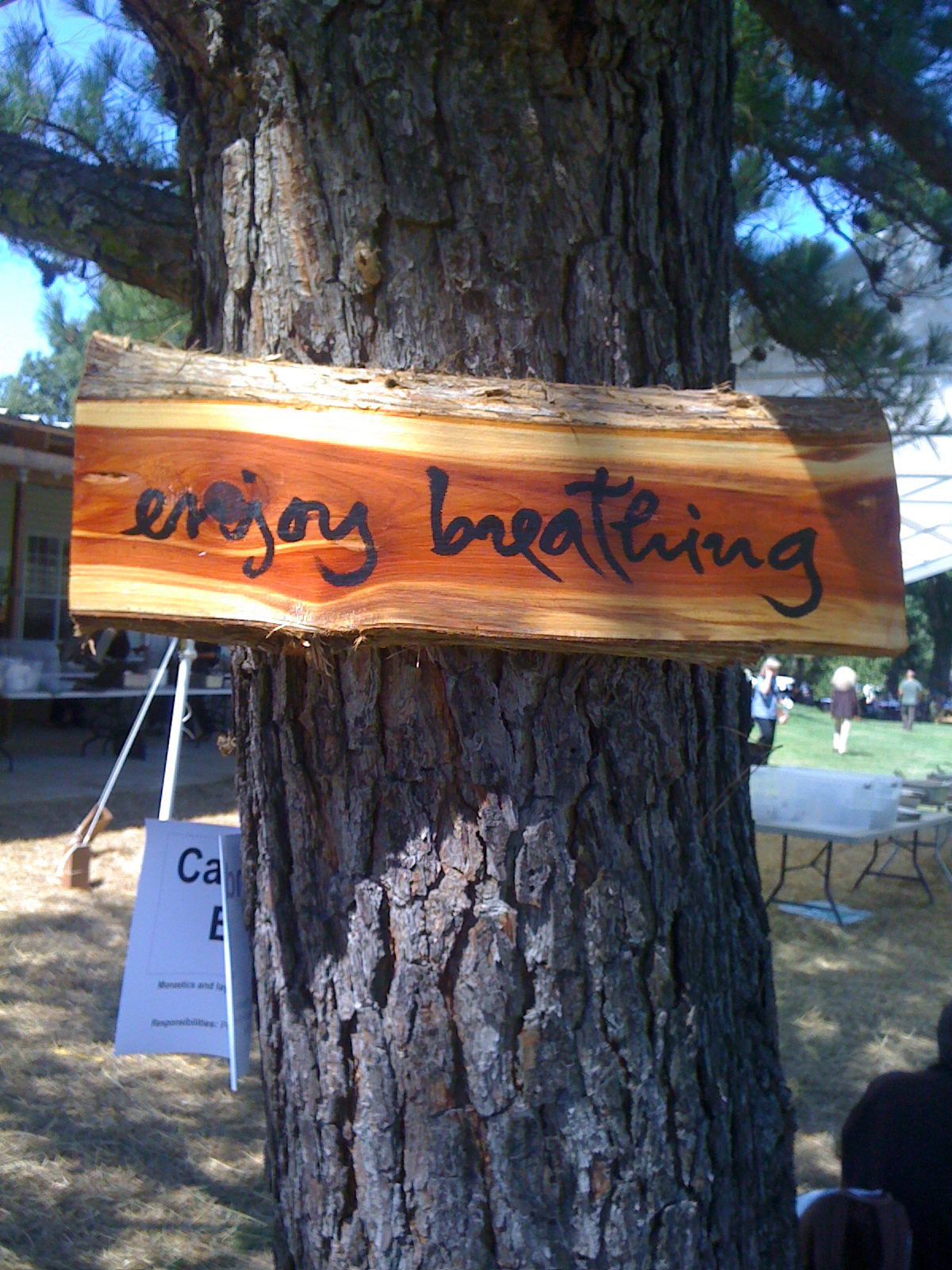
Reminders everywhere :)

Thay's notes.

The alter in the meditation tent.  Notice the lack of deities.

The alter says: "I have arrived.  I am home."

The mindfulness bell.

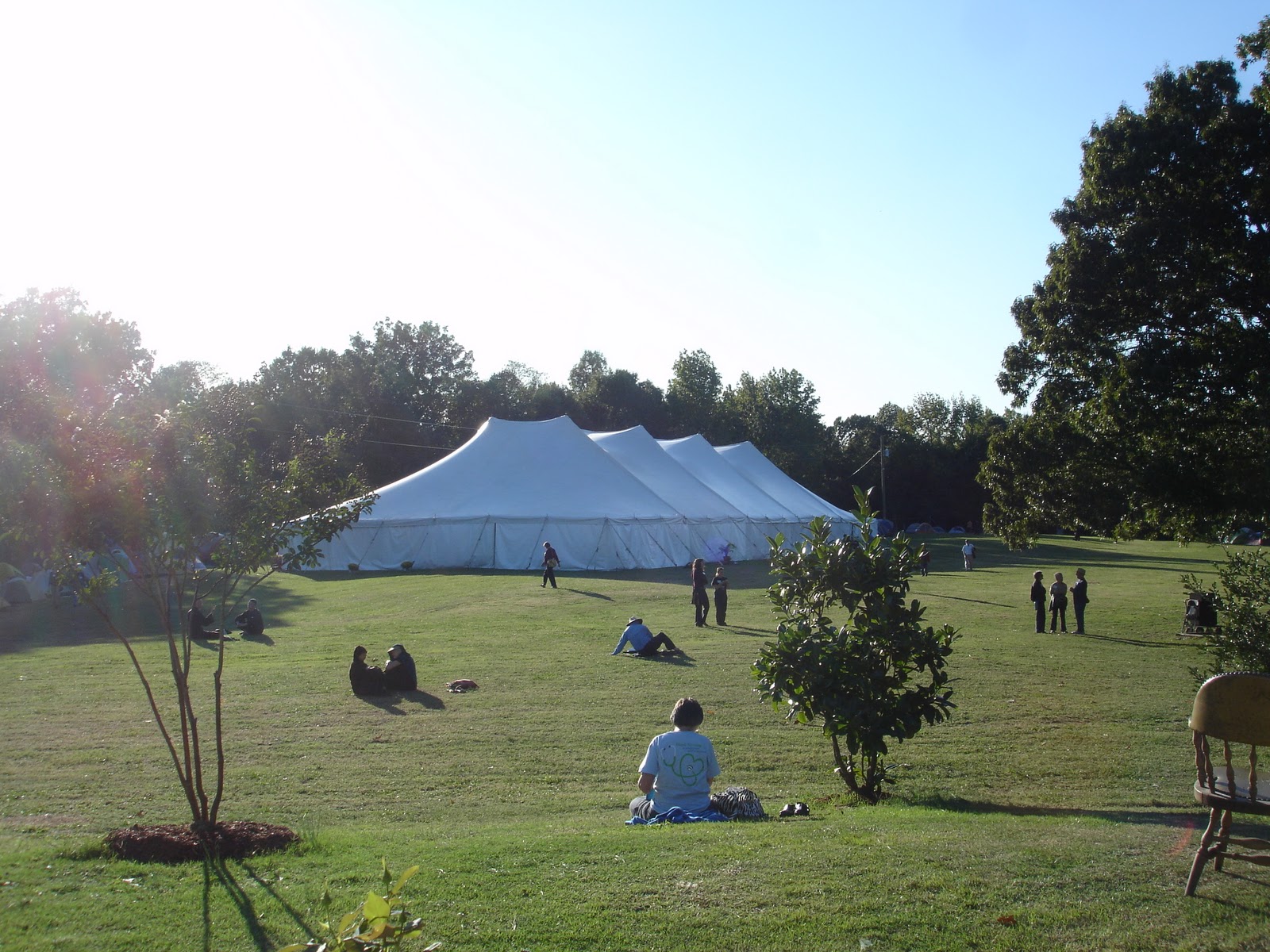
The meditation tent.

Thay jots down notes as he lectures.

View from our tent.  That's the nun's residence in the background.

Another view from our tent.

Our "home" started to get a little wonky by the end of the week :)

Late afternoon sun on the grape arbor.


Garden.


One of the out buildings...a storage shed, I think.

This is where the nuns live.  Their rooms are downstairs and they have a meditation space on the second floor.


Sun on the path outside the nun's residence.

Late afternoon sun.

Near the nun's residence, on the way to our tent.

Behind the dining hall. The tent to the right is where we washed our dishes.

The back of the dining hall (to the right) and the dish washing tent (to the left). 


One of the monastics.

Setting up the dish washing stations.

Sunny slope behind the dining hall.  A great place to get warm in the afternoon.

Behind the dining hall.  The meditation tent is to the left and the bathhouse straight ahead and to the right.

Meditation tent.

Men's camp ground.

Back of the Buddha Hall.

Side of the Buddha Hall.  This was where all of our announcements or messages were posted.  There were always many smiling monks or nuns peacefully gathered there.


The beautiful sister Chan Khong.


Sister Chan Khong signing her book.


No mud, no lotus.


One of the many lovely aspects of the retreat was, if you had a question about your practice, or had something weighing on you, one of Thay's monastics from Plum Village would happily set up a consultation with you and help you in any way they could.  The beautiful sister Huang Hau helped me in SO many ways.  


Walking with Thay.


Thay on a chilly morning, making his way to the meditation tent.


Watching Thay pass by.

Walking behind Thay.

Enjoying the present moment together.


Soaking up the exquisite sunshine on a cold morning.  Lyn, on the right was one of the first people we encountered at Magnolia.

Sitting in the sun with Thay.


One of the monks stopping to smell the flowers (and gather them too!).


Dear, sweet Thay.  This photo was taken by one of our work family members, John Cotterman. He has such a great eye.

Beloved teacher.